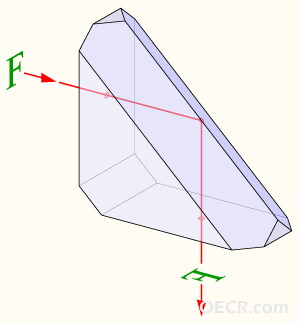
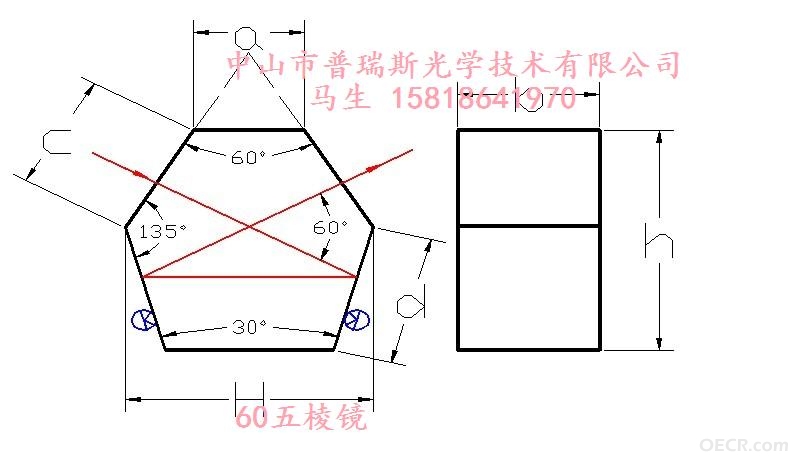
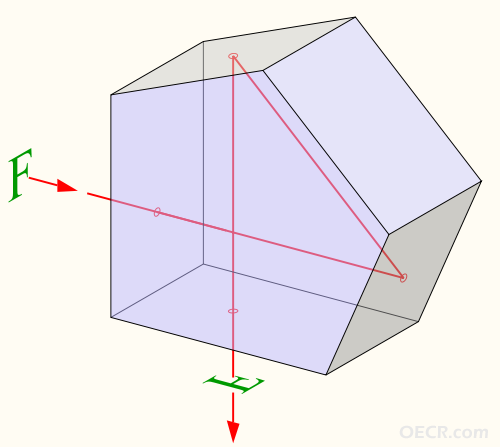
A pentaprism is a five-sided reflecting prism used to deviate a beam of light by 90°. The beam reflects inside the prism twice,[1] allowing the transmission of an image through a right angle without inverting it (that is, without changing the image's handedness) as an ordinary right-angle prism or mirror would.
The reflections inside the prism are not caused by total internal reflection, since the beams are incident at an angle less than the critical angle, or minimum angle for total internal reflection. Instead, the two faces are coated to provide mirror surfaces. The two opposite transmitting faces are often coated with an antireflection coating to reduce spurious reflections. The fifth face of the prism is not used optically, but truncates what would otherwise be an awkward angle joining the two mirrored faces.
艾萨克·牛顿是第一个注意到棱镜将无色的光分裂出颜色的科学家。牛顿安置了第二个棱镜让分裂出颜色后的光线穿过,但是光的颜色不会再改变,因此他认为棱镜能分离颜色。他也利用透镜和第二个棱镜将彩虹重组成白光。这个实验在科学革命期间成为新科学方法很有名的一个例子。这个实验的结果显然改变了形而上学,导致约翰·洛克primary vs secondary quality distinction的崛起。
 关注公众号
关注公众号

 IP卡
IP卡 狗仔卡
狗仔卡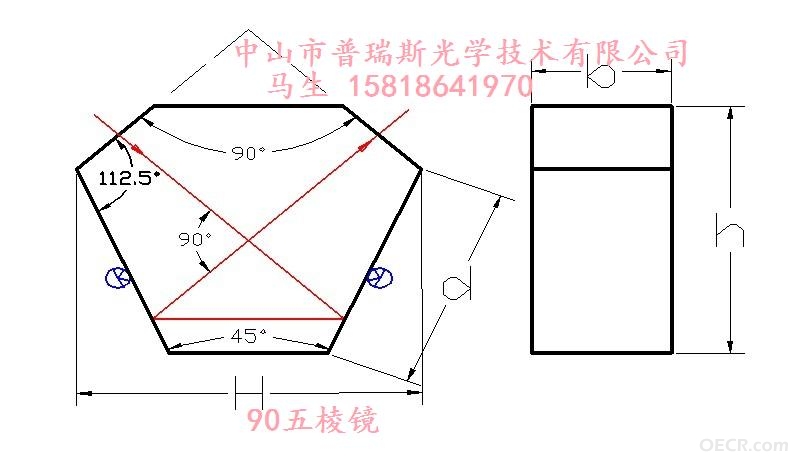
 显身卡
显身卡
 发表于 2010-4-30 21:03:36